
OB1
Open Brain — The infrastructure layer for your thinking. One database, one AI gateway, one chat channel — any AI plugs in. No middleware, no SaaS. - NateBJones-Projects/OB1
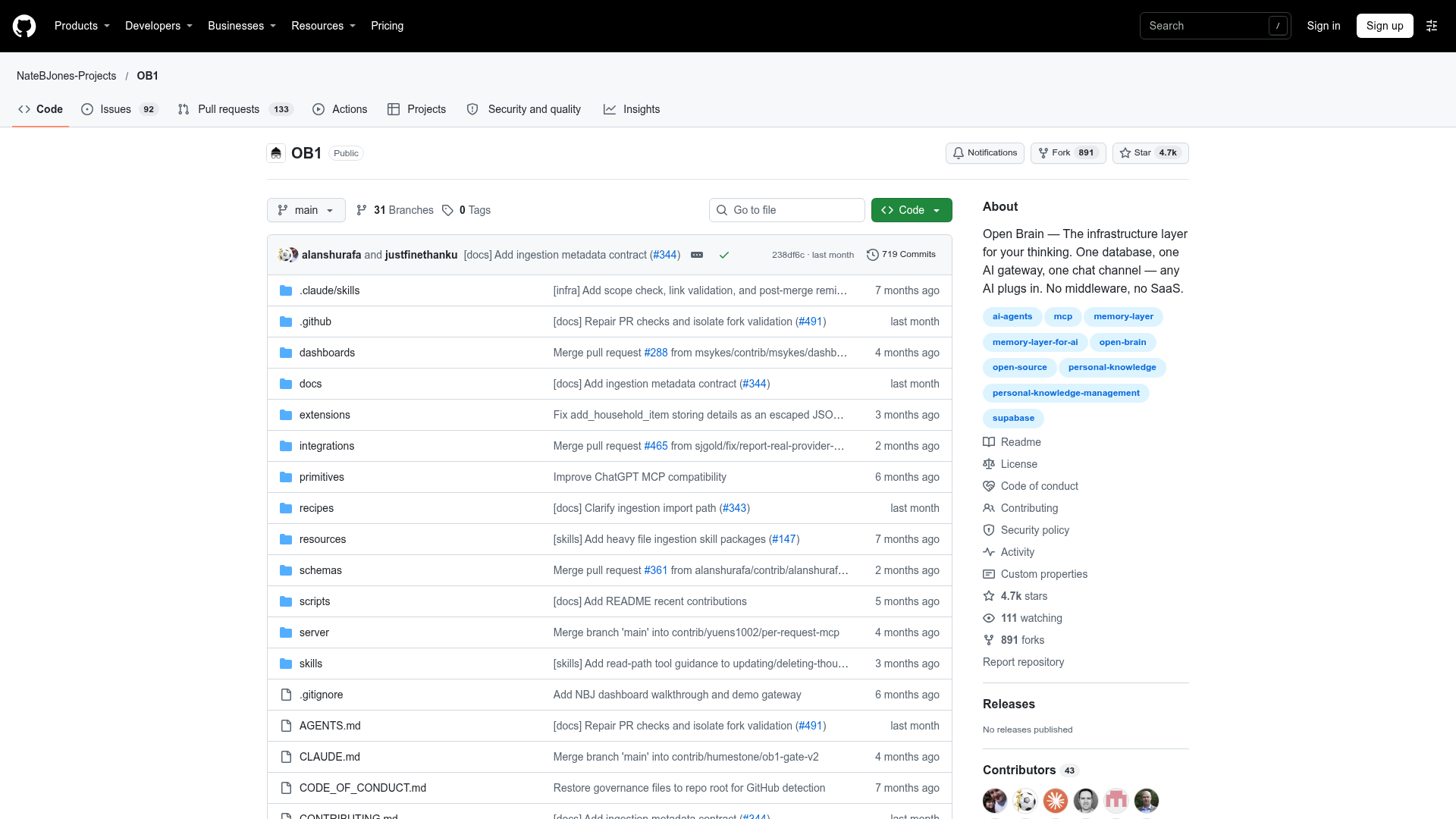
OB1 at a Glance
- How you use it
- Self-hosted database, AI gateway, and chat capture system connected to AI clients
- Who it's for
- People who want AI tools to share persistent personal memory
- Works with
- Claude ChatGPT Cursor Slack MCP
OB1 Key Features
- MCP server
- Persistent AI memory
- Thought capture
- Vector search
Can't Find What You're Looking For?
We build custom AI agents tailored to your specific business needs. From ideation to deployment, TinyAI.Tools is your partner in AI innovation.
No commitment required. Let's discuss your ideas.
OB1 Alternatives
metronix-memory
Metronix is open-source, self-hosted memory infrastructure for AI agents with persistent memory, structured state, permissions, checkpoints, and audit trails.
memorax-code
MemoraX Code is a memory plugin for AI coding that brings Coding, Repo, Personal, and Procedure Memory into real Codex and Claude Code tasks.
tenuo
Give AI agents task-scoped authority, check every action before it runs, and narrow permissions across delegation. Open source, Apache 2.0.
mnemo-cortex
Mnemo Cortex — cognitive coprocessor with active memory. It's not just memory, it's cognitive coprocessing. Three-layer architecture: Mnemo (source of truth) + The Librarian (document discovery) + Brain Files (live state). Cortex Stick carries memory
codex-memories
Local-first persistent memory for OpenAI Codex: governed recall, progressive disclosure, no hosted vector database. - libenxier-beep/codex-memories

SodaMem
SodaMem is a self-evolving, agentic memory layer for AI agents.