
Keep the Why
The why layer of repo-native project memory: the reasoning behind a codebase as Markdown in the repo, versioned by Git, for coding agents and humans, so nothing rejected is proposed twice.
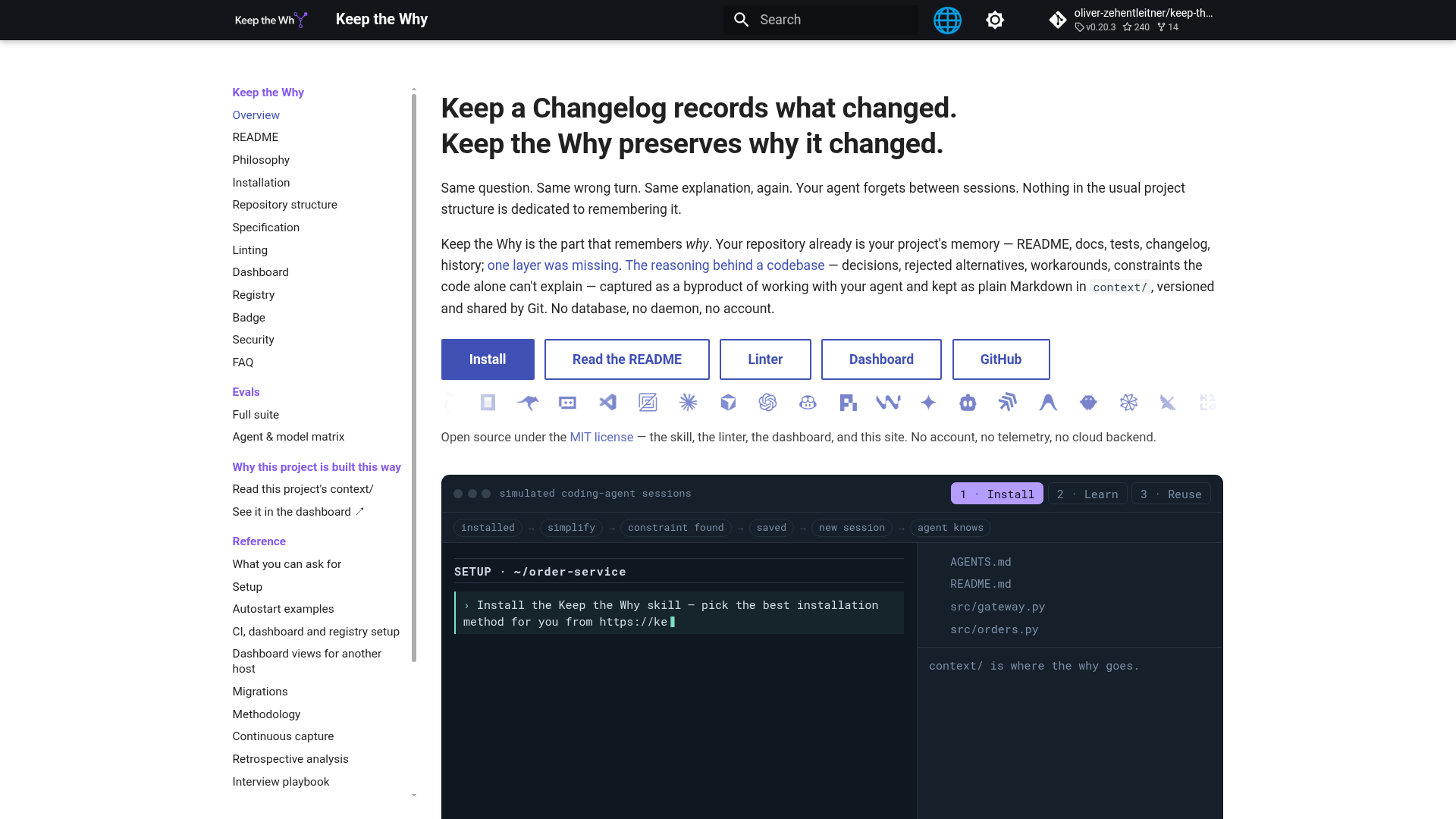
Keep the Why at a Glance
- Pricing
- Free
- How you use it
- Install as a skill for a coding agent; it stores project context as Markdown in the repository.
- Who it's for
- Coding agents and the humans working with them.
- Works with
- Claude Code Cursor Codex GitHub Copilot Pi
Keep the Why Key Features
- Markdown context files
- Project rationale memory
- Read-only dashboard
- Repository linting
Can't Find What You're Looking For?
We build custom AI agents tailored to your specific business needs. From ideation to deployment, TinyAI.Tools is your partner in AI innovation.
No commitment required. Let's discuss your ideas.
Keep the Why Alternatives

Repo Context Ledger
面向 AI 上下文管理的 Agent Skill:为 Codex 上下文管理、Cursor 上下文切换和 Claude 上下文管理提供跨窗口续接,用 Git 保存可验证的功能说明与变更记录。AI coding context management and agent handoffs. - gviiisen/repo-context-ledger
turbo-flow
Turbo Flow is the open-source rules layer for AI-written code: rig-lite, a portable governance kit — fail-closed cross-model review gate, constitution, git-versioned memory. Works with any harness. Agents build, humans merge.
datachain
The Context Layer for unstructured data: typed, versioned datasets over S3, GCS, Azure - datachain-ai/datachain
Slipdock
Agent-native infrastructure: domains, DNS, a free private git repo and push-to-deploy hosting behind one API token an AI agent gets in its first second.
Codev
Codev helps humans and agents co-develop both the context and the code of the project.
contextual-commits
An open standard for capturing the WHY in git history - berserkdisruptors/contextual-commits