dreamgraph
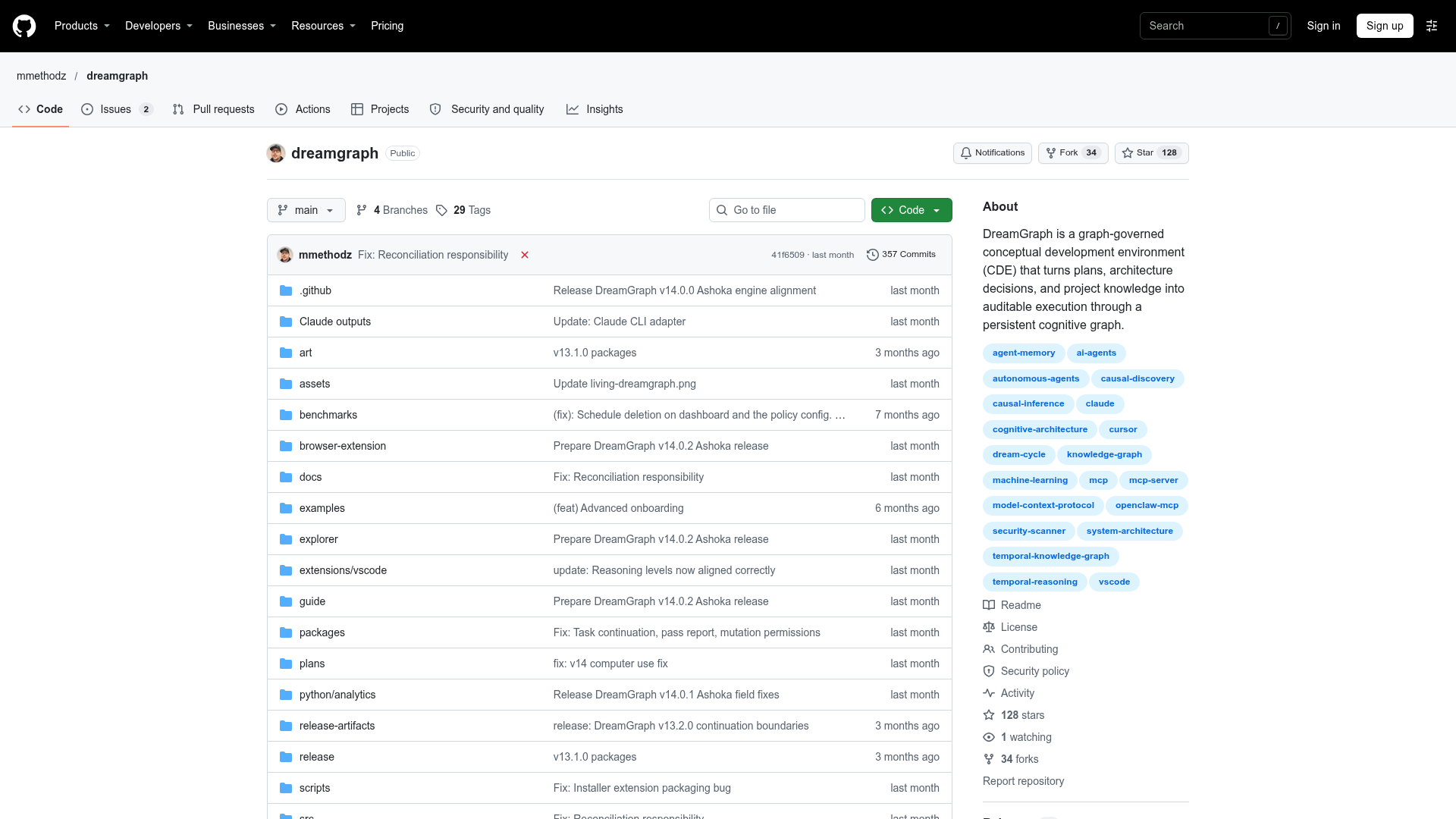
DreamGraph is a graph-governed conceptual development environment (CDE) that turns plans, architecture decisions, and project knowledge into auditable execution through a persistent cognitive graph. - mmethodz/dreamgraph
dreamgraph at a Glance
- How you use it
- Daemon, CLI, VS Code extension, and browser Architect
- Who it's for
- Developers working with software repositories and architecture
- Works with
- MCP VS Code Codex CLI Ollama LM Studio
dreamgraph Key Features
- Architecture-aware reasoning
- Auditable code changes
- Governed tool use
- Persistent project knowledge
- Repository understanding
Can't Find What You're Looking For?
We build custom AI agents tailored to your specific business needs. From ideation to deployment, TinyAI.Tools is your partner in AI innovation.
No commitment required. Let's discuss your ideas.
dreamgraph Alternatives
OpenGiraffe
A persistent, daemon-based multi-agent system that leverages opencode to automatically discover, plan, implement, and review code changes across a codebase. - zclllyybb/OpenGiraffe
beevibe-cto
Architecture Deep Research: deep research for strategic system design decisions. - beevibe-ai/beevibe-cto
MegaMemory
Persistent project knowledge graph for coding agents. MCP server with semantic search, in-process embeddings, and web explorer. - 0xK3vin/MegaMemory
Fay
Build powerful AI agents and automations without writing code. Fay's Architect turns plain language into deployed agents in minutes. Free to start.
recall
Persistent memory for your coding agent, free on your subscription: the summary is a local algorithm, not an LLM call, and your transcripts never leave your machine.
YantrikDB
YantrikDB is a persistent cognitive memory database for AI agents: semantic recall, a knowledge graph, temporal decay, consolidation, and review of recognized structured conflicts. Run it as an embeddable Rust engine, Python package, MCP server, or r