
codeArbiter
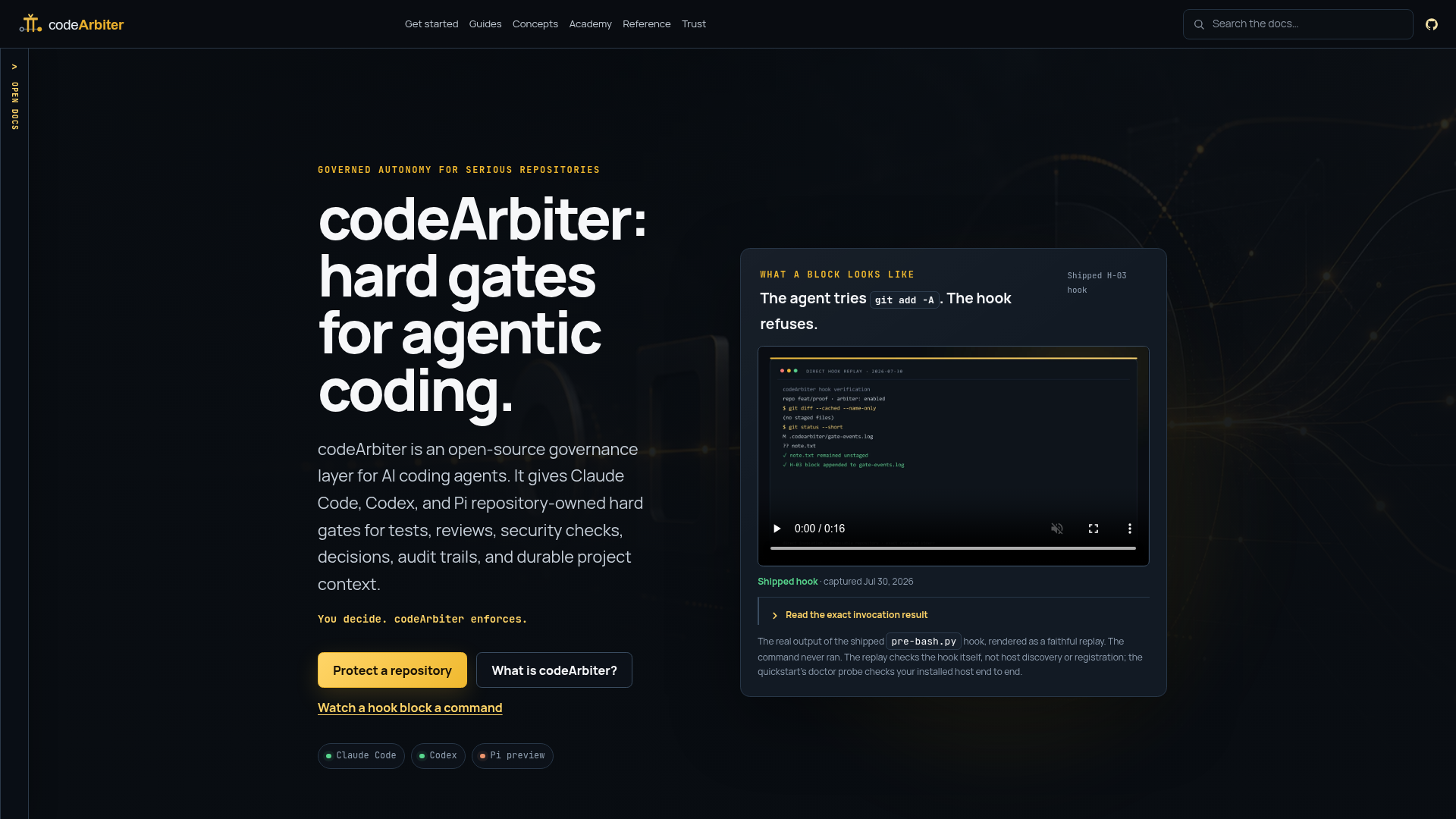
codeArbiter is an open-source governance layer for AI coding agents, with repository-owned hard gates, reviews, audit trails, and durable project context for Claude Code, Codex, and Pi.
codeArbiter at a Glance
- Pricing
- Free
- How you use it
- Install it for a supported coding-agent host and opt a repository in; enforcement runs locally.
- Who it's for
- Teams using AI coding agents on repositories that need governed changes, reviews, and audit trails.
- Works with
- Claude Code Codex Pi
codeArbiter Key Features
- audit trails
- durable project context
- repository-owned gates
- security checks
- test and review enforcement
Can't Find What You're Looking For?
We build custom AI agents tailored to your specific business needs. From ideation to deployment, TinyAI.Tools is your partner in AI innovation.
No commitment required. Let's discuss your ideas.
codeArbiter Alternatives
OpenCode Power Pack
Use 55 Agent Skills for Claude Code, Codex, OpenCode, and Pi, with an opt-in native sandbox runner for contained commands.
wicked-studio
The IDE for running a team of coding agents. Chat with Claude Code, Codex, Copilot, OpenCode and Pi, watch the work happen live, answer the gates that need you, and approve what changed. A different agent reviews every change, and the wicked-crew dae
vibecosystem
Profile-based coding runtime for Claude Code and Codex. Lean core; opt-in quality, context, memory, orchestration and dashboard. - vibeeval/vibecosystem
Gatehouse
Runtime policy enforcement, a named approver for the hard calls, and a sealed audit trail. Gatehouse is the control plane for organisations that need AI agents their security and compliance teams can approve.
spec-first
spec-first 是面向 Claude Code 和 Codex 的工程化 AI Coding harness,把需求、计划、代码、评审、验证证据与可复用知识连接成一条留在仓库里的完整闭环。
metronix-memory
Metronix is open-source, self-hosted memory infrastructure for AI agents with persistent memory, structured state, permissions, checkpoints, and audit trails.