brain.md
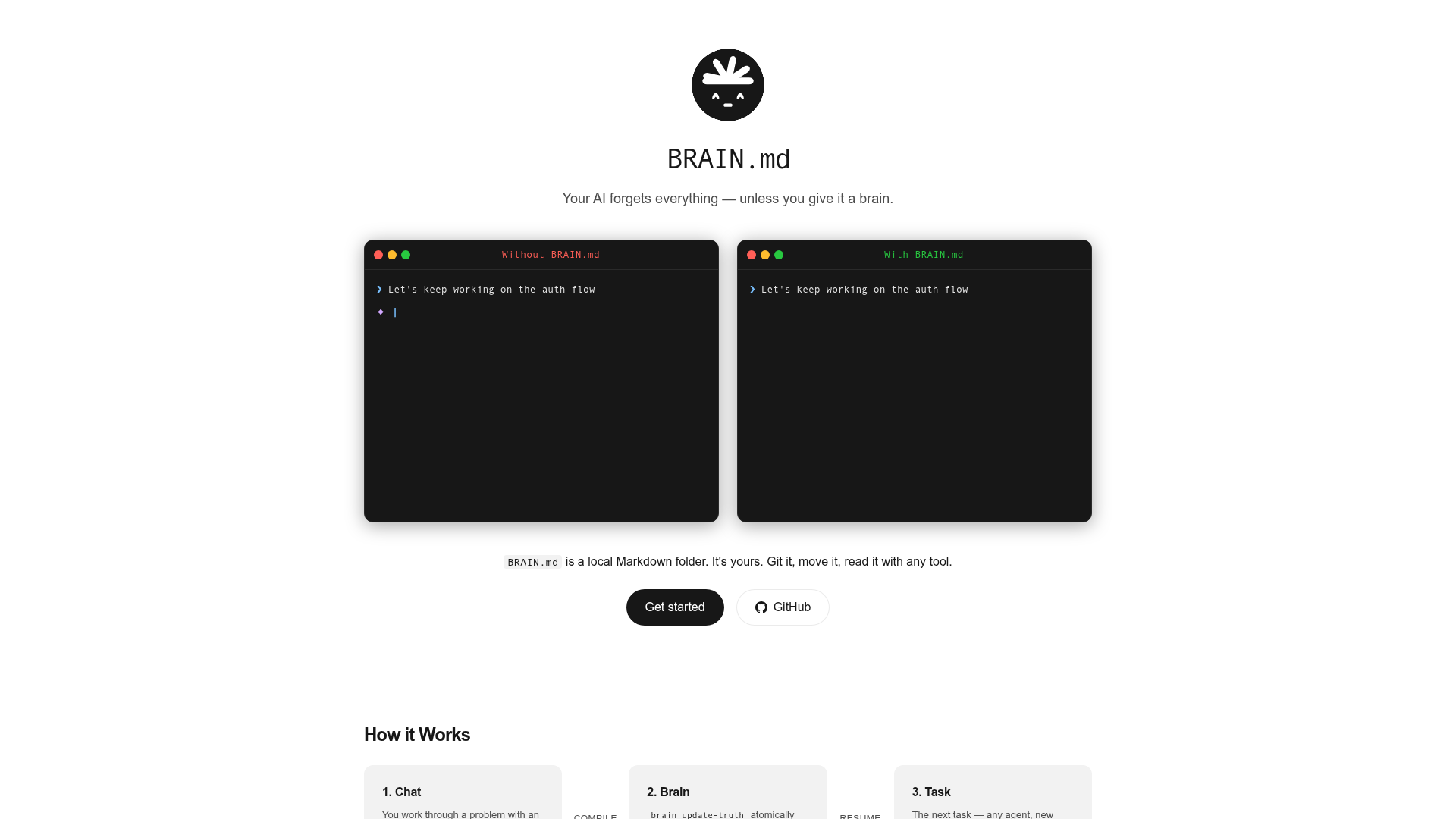
An open, agent-agnostic standard for capturing a project's durable knowledge as plain Markdown — read and written through one small CLI. It lives in your repo and travels across agents, machines, and models.
brain.md at a Glance
- How you use it
- Install the CLI, initialize a project, and use the brain/ Markdown files through coding agents.
- Who it's for
- Developers working with AI coding agents
- Works with
- Claude Code Codex Cursor Pi OpenCode
brain.md Key Features
- Agent-shared knowledge
- CLI-based updates
- Decision tracking
- Markdown knowledge base
- Persistent project memory
Can't Find What You're Looking For?
We build custom AI agents tailored to your specific business needs. From ideation to deployment, TinyAI.Tools is your partner in AI innovation.
No commitment required. Let's discuss your ideas.
brain.md Alternatives
contextual-commits
An open standard for capturing the WHY in git history - berserkdisruptors/contextual-commits
the-curator
Your brain, then your team's brain, then your agents' brain. Drop in documents and it compounds them into an interlinked markdown wiki you own — readable in Obsidian, synced through your own private GitHub repo. Share it with a cohort. Coding agents
aikito
Your durable workspace across AI agents.
deep-research-skill
让AI Agent 做真正会思考,有判断的深度调研,而不是会摆信息的汇总报告。一个即插即用的 skill 文件。 - SeanEllyJames/deep-research-skill
qwen-code
An open-source AI coding agent that lives in your terminal. - QwenLM/qwen-code
remnic
Open-source, local-first memory for AI agents. Claude Code, Codex CLI, Cursor, ChatGPT, and every MCP client share one memory store: plain markdown files on your machine. MIT, free forever.